
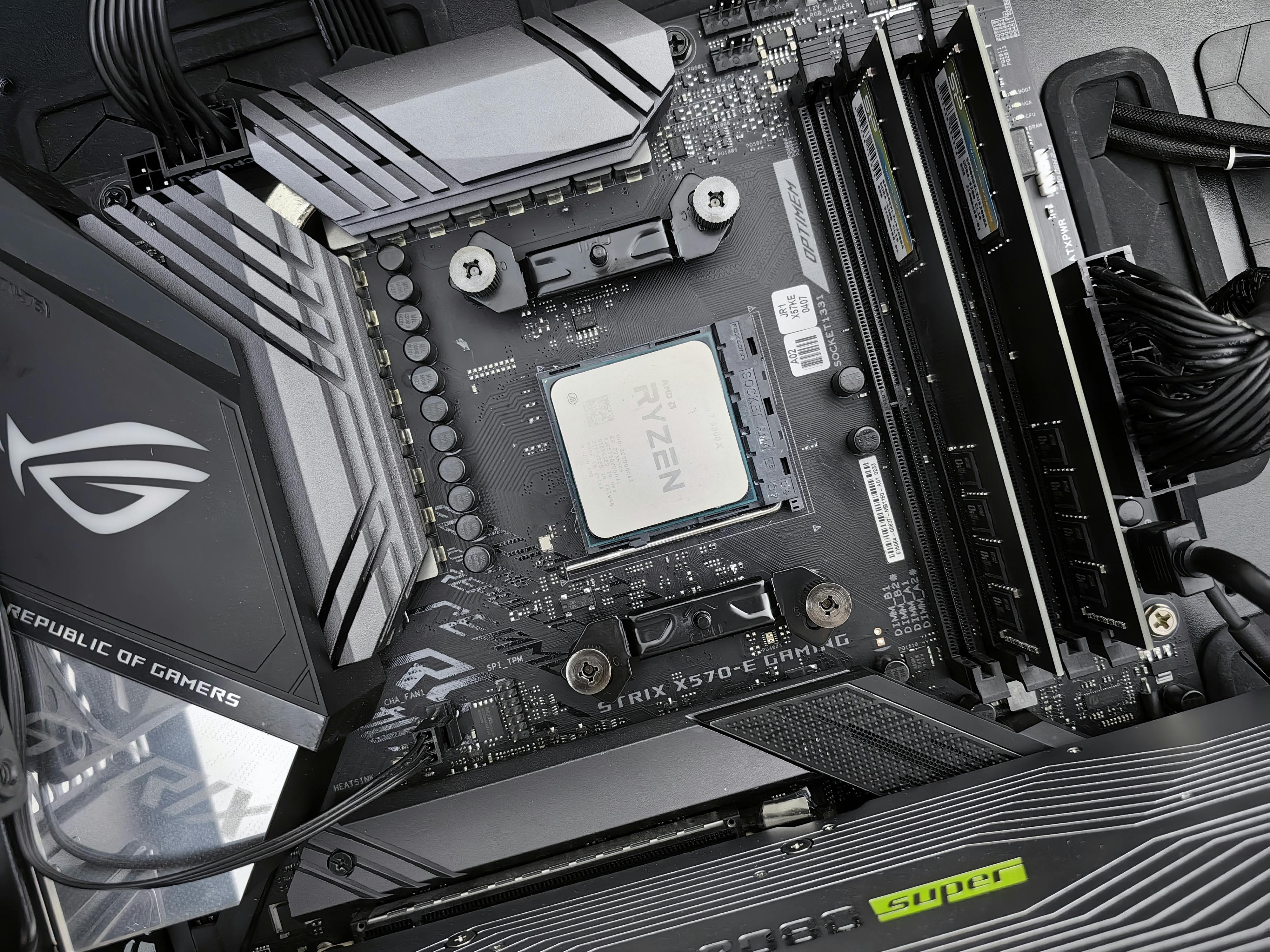
Imagine waking up to find your meticulously crafted, top-tier gaming rig – the beast you poured thousands into, the one that crushed every benchmark – is suddenly… a relic. Not slowly, not over years, but *overnight*. The frames per second you boasted about, the ultra-settings you reveled in, are now a stuttering, pixelated mess compared to what’s possible. A seismic shift in hardware, one nobody saw coming, has just redefined gaming. Your PC isn't just outdated; it's functionally obsolete for the future. Are you ready for the revolution that just hit your desk?
🔥 What's Happening Right Now
For decades, the trajectory of gaming hardware was predictable: bigger, faster, more cores, more VRAM. Each new generation offered incremental (or sometimes significant) improvements, but the fundamental architecture remained largely the same. You knew your RTX 4090 or Ryzen 9 7950X was a beast, future-proofed for at least a few years. That era, my friends, ended last night.
The "Hardware Revolution Nobody Predicted" isn't about a new GPU series with 20% more performance. It's about a fundamental paradigm shift in how computing itself works, spearheaded by the advent of mass-producible Adaptive Neural Processing Units (ANPUs). For years, AI was software; now, it’s literally baked into the silicon at a molecular level, allowing chips to dynamically reconfigure their architecture and instruction sets *in real-time* based on the specific demands of the task at hand. Think of it not as a faster engine, but as an engine that can instantly transform into a jet, a submarine, or a tank, perfectly optimized for its current environment.
This breakthrough, initially developed in classified research labs for complex scientific simulations, has suddenly broken into the consumer market. A confluence of advancements in neuromorphic computing, quantum tunneling materials, and self-optimizing AI algorithms has allowed manufacturers to produce ANPUs that don't just *process* data; they *understand* it. When you launch a game on an ANPU-powered system, the chip doesn't just run instructions; it analyzes the game engine's core logic, predicts player actions, models environmental interactions, and reconfigures its entire processing pipeline to deliver an unprecedented, hyper-realistic, and truly intelligent experience.
The impact on gaming is nothing short of catastrophic for traditional hardware. New titles, designed from the ground up to leverage ANPU's adaptive capabilities, simply *cannot* run on conventional CPUs and GPUs. We're not talking about low frame rates or reduced settings; we're talking about fundamental game mechanics, AI behaviors, and physics simulations that rely on the ANPU's ability to dynamically allocate resources and even rewrite its own processing pathways. Imagine a game where every NPC learns your playstyle in real-time, every particle in a storm interacts uniquely with the environment, and every bullet trajectory is influenced by micro-atmospheric conditions – all calculated by an ANPU that understands the simulation at a level no fixed-architecture chip ever could.
The first wave of ANPU-native games, like "Chrono-Shift Saga: Reality Reborn" and "Ascension Protocol," are already hitting digital storefronts. Early access players with ANPU systems are reporting experiences so immersive and fluid that they describe their old 4K, 144Hz setups as feeling like "playing a slideshow." This isn't just about graphics; it's about a level of interactivity, intelligence, and dynamic realism that makes your current gaming PC, no matter how powerful, utterly incapable of delivering the intended experience. It's not a performance gap; it's an architectural chasm. Your gaming PC didn't just get slower; it fundamentally speaks a different language than the future of gaming.
💡 Financial Impact
The tremors of this hardware revolution are sending shockwaves through every corner of the gaming and tech industries, with profound financial implications for manufacturers, retailers, and especially, you, the gamer. The immediate effect has been a sudden and unprecedented devaluation of all existing gaming hardware. That top-tier GPU you bought last month? Its resale value just plummeted faster than a lead balloon. Secondary markets for used PCs and components have evaporated overnight, leaving countless gamers with high-value investments that are now functionally worthless for the new era of gaming.
For hardware manufacturers, this is a crucible. Companies that saw the writing on the wall and invested heavily in ANPU research, like QuantumCore Systems and Neuralink Compute (hypothetical), are now poised to dominate the market. Their stock prices are soaring, and pre-orders for their inaugural ANPU-powered systems are through the roof. Conversely, traditional giants who were slow to adapt, clinging to the old CPU/GPU paradigms, are facing an existential crisis. Their research and development pipelines, geared towards incremental improvements, are now obsolete, and their market share is bleeding away. This isn't just a challenge; it's a potential extinction event for those unwilling or unable to pivot rapidly.
The retail landscape is also undergoing a seismic shift. Stores are scrambling to liquidate their "legacy" gaming PC inventory at fire-sale prices, while simultaneously trying to secure limited shipments of the new ANPU-compatible systems. This creates a volatile market where early adopters are paying a premium for cutting-edge tech, while those clinging to older systems find themselves shut out of the most exciting new releases.
For consumers, the financial impact is dual-edged. On one hand, the cost of entry into the ANPU era is currently high. A full, ready-to-play ANPU system can easily exceed $5,000, placing it out of reach for many. This high barrier to entry could create a temporary divide in the gaming community, between those who can afford the future and those who are left behind with their legacy machines. However, it also opens doors for new business models. We're already seeing the rise of "hardware-as-a-service" subscriptions, where cloud gaming providers leverage massive ANPU server farms to stream the latest titles, making the technology accessible without the prohibitive upfront cost. This shifts the financial burden from a large, one-time investment to a more manageable recurring expense, but also means gamers are renting, not owning, their access to the bleeding edge.
Furthermore, the revolution is creating entirely new markets for specialized peripherals and accessories. ANPUs require advanced cooling solutions, specialized power delivery, and motherboards designed for their unique architecture. This means new opportunities for manufacturers of components, but also additional costs for gamers looking to build or upgrade. The gaming industry's financial ecosystem is being completely rewritten, and understanding these shifts is crucial for anyone looking to stay ahead of the curve, or simply keep playing the games they love.
💰 Best Options in Comparison
With your trusty gaming PC suddenly relegated to the status of a digital antique, the critical question becomes: What now? The options are diverse, each with its own set of trade-offs regarding performance, cost, and future-proofing. Navigating this new landscape requires careful consideration of your budget, your gaming habits, and your willingness to embrace cutting-edge (and expensive) technology. Here's a breakdown of your best paths forward in the ANPU era:
| Option | Description | Performance (New Gen Games) | Estimated Cost | Future-Proofing | Recommended For |
|---|---|---|---|---|---|
| The "Apex Predator" Upgrade | A complete, custom-built system featuring the latest Adaptive Neural Processing Unit (ANPU), a compatible motherboard, and optimized components designed for the new architecture. This is a full leap into the future. | Unrivaled. Flawless 4K+ at ultra-settings, experiencing ANPU-native games exactly as developers intended, with unprecedented realism and dynamic intelligence. | $$$ (Premium Investment, often $5,000+) | High. Built for the next 3-5 years of ANPU-native titles and future advancements, offering the longest lifespan in this new paradigm. | Hardcore enthusiasts, competitive gamers, professional content creators, early adopters who demand the absolute peak of gaming performance and immersion, regardless of cost. |
| The "Hybrid Core" Solution | For those with recent high-end PCs, this involves upgrading core components (e.g., purchasing an ANPU add-in card, a compatible ANPU-ready motherboard, and potentially a new power supply) to integrate ANPU capabilities with existing parts. | Excellent. Near-Apex performance, especially for ANPU-accelerated tasks. May experience minor bottlenecks on non-ANPU specific workloads compared to a full ANPU system, but vastly superior to legacy hardware. | $$ (Significant Investment, often $2,000-$4,000) | Moderate. Bridges the gap effectively, extending the life of some existing components, but a full system integration remains the ideal for long-term optimization. | Enthusiasts with relatively new, powerful PCs looking to extend their investment, gain access to ANPU titles, and avoid a complete system rebuild immediately. |
| The "Cloud Nexus" Subscription | Leveraging cloud gaming services that have rapidly deployed ANPU-powered server farms. You stream the game to your existing devices (PC, TV, mobile) without needing local ANPU hardware. | Very Good. Performance is heavily dependent on your internet bandwidth, latency, and the quality of the service provider. Offers access to new ANPU games without buying hardware. | $ (Affordable Monthly/Annual Fee) | Low (Hardware not owned). Future-proofing is entirely dependent on the cloud service provider's continuous innovation and infrastructure upgrades. | Casual gamers, those on a strict budget, players with excellent and stable internet connections, or individuals who prefer a "pay-as-you-go" model while waiting for ANPU hardware prices to stabilize. |
| The "Legacy Gamer" Path | Choosing to stick with your current, pre-ANPU gaming PC. This means focusing solely on your existing library of games or new titles that specifically avoid ANPU-native architectures (which will become increasingly rare). | Poor (for new ANPU titles). Excellent for your existing game library and older, non-ANPU optimized releases. You will be unable to play the most groundbreaking new games. | $ (Zero immediate cost) | Very Low. Will rapidly fall behind new game releases and the evolving gaming landscape. Becomes a niche experience. | Budget-conscious gamers, those not interested in the latest AAA titles, players with limited upgrade options, or those content to explore the vast back catalog of pre-ANPU games. |
Conclusion
The "Hardware Revolution Nobody Predicted" isn't a speculative future; it's here, and it has irrevocably changed the landscape of PC gaming overnight. Your once-mighty gaming rig, the pinnacle of yesterday's technology, now stands at a crossroads – a testament to an era that has rapidly drawn to a close. This isn't merely an upgrade cycle; it's a fundamental architectural shift, driven by Adaptive Neural Processing Units, that redefines what a game can be and how it's experienced.
The financial implications are vast, impacting everything from your personal budget to the titans of the tech industry. While the initial shock can be unsettling, this revolution also ushers in an era of unprecedented immersion, intelligence, and dynamic realism in gaming. The choices you make now will determine whether you're at the forefront of this new frontier or observing it from the sidelines. Whether you opt for the bleeding-edge "Apex Predator" system, a strategic "Hybrid Core" upgrade, or embrace the accessibility of "Cloud Nexus" subscriptions, adaptability is key. Don't be left behind in the dust of legacy hardware; the future of gaming is here, and it demands a new approach. Stay informed, stay ready, and let gameserrari.com guide you through this exhilarating, albeit disruptive, new chapter in gaming history.