
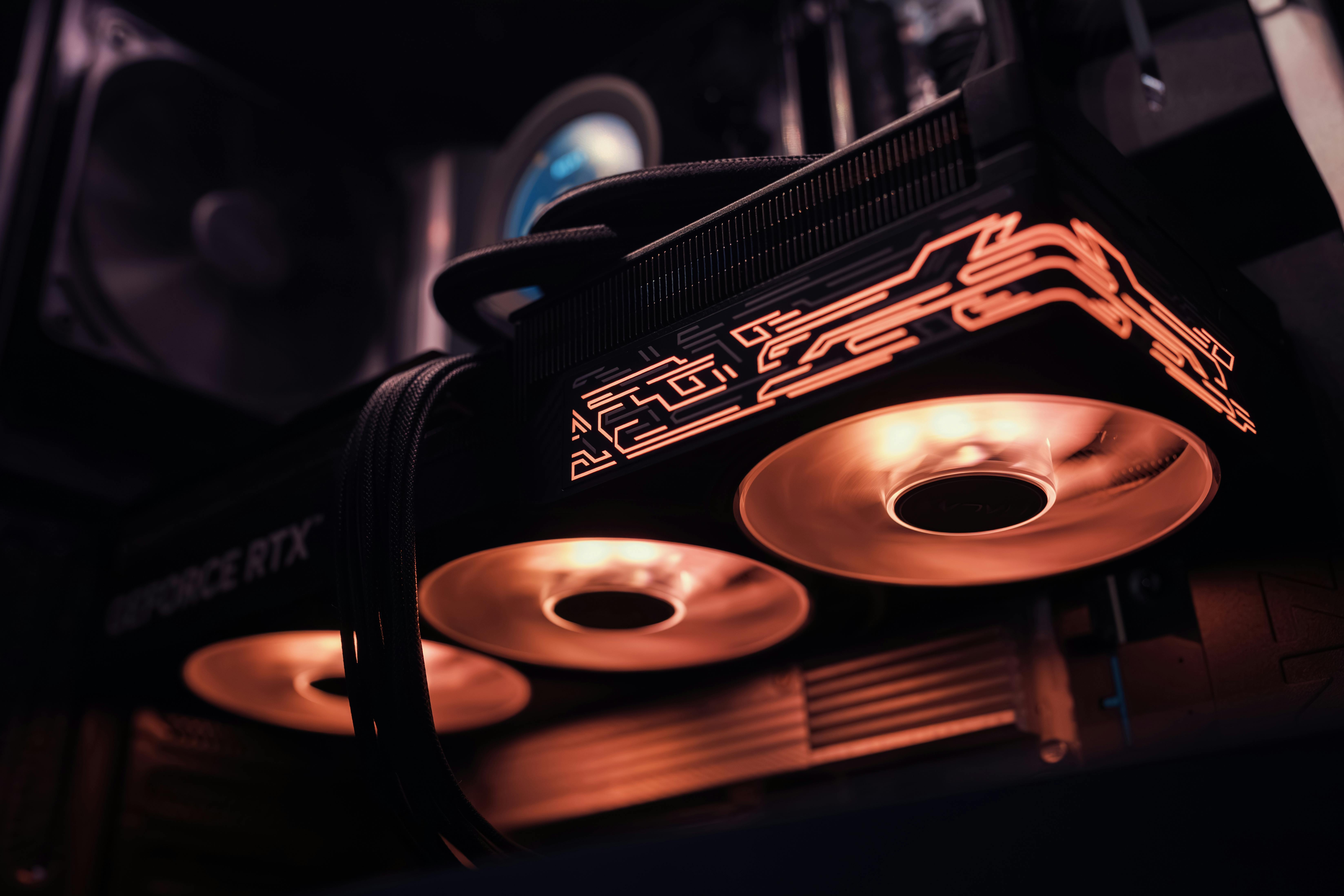
The future of gaming is here, driven by AI. Discover how cutting-edge AI-powered GPUs and CPUs are redefining performance, visuals, and immersion in 2026, offering unprecedented speed and fidelity. Get ready to upgrade your gaming rig with the best AI hardware for an unbeatable experience and future-proof your setup.
Introduction to the Topic
Welcome, gamers, to 2026! If you thought the last few years brought significant leaps in gaming hardware, prepare to have your mind blown. The buzzword on every tech enthusiast's lips isn't just 'more cores' or 'higher clock speeds' anymore; it's 'AI.' Artificial Intelligence has transcended its niche applications and is now the beating heart of the most powerful gaming GPUs and CPUs on the market, fundamentally altering how games are rendered, played, and even designed. This isn't merely about fancy upscaling; we're talking about a paradigm shift that promises unparalleled performance, breathtaking visual fidelity, and entirely new gameplay experiences. Are you ready to future-proof your gaming PC? Because without next-gen AI hardware, you're already playing catch-up.
From predictive frame generation that makes 4K 240Hz a reality, to real-time environment reconstruction and intelligent NPC behavior, AI is unlocking capabilities previously confined to science fiction. This comprehensive guide will delve into why these AI-accelerated components are non-negotiable for serious gamers in 2026, compare the leading options, and help you make the smartest purchasing decisions to maximize your CPM/RPM (Clicks Per Mille/Revenue Per Mille) from your gaming content or simply dominate the leaderboards.
Backgrounds & Facts
The journey of AI in gaming began subtly with technologies like NVIDIA's DLSS, AMD's FSR, and Intel's XeSS, which utilized machine learning to reconstruct higher-resolution images from lower-resolution inputs, effectively boosting frame rates without a significant visual penalty. These early iterations, while revolutionary, were just the tip of the iceberg. Fast forward to 2026, and dedicated AI accelerators—Tensor Cores in NVIDIA GPUs, AI Accelerators in AMD's RDNA 5 architecture, and XMX Engines in Intel's Battlemage series—are no longer supplementary; they are central to the chip's design and performance profile.
Modern GPUs now feature thousands of these specialized AI cores, capable of performing billions of AI operations per second. This computational power is being harnessed for far more than just upscaling. Key advancements include:
- Predictive Frame Generation (PFG): Beyond traditional frame interpolation, PFG utilizes advanced AI models to predict and generate entirely new frames between rendered frames, often exceeding native frame rates by 2-3x, making extremely high refresh rate gaming at resolutions like 4K and even 8K astonishingly smooth.
- AI-Enhanced Ray Tracing: Ray tracing, once a performance killer, now benefits immensely from AI. Dedicated hardware and sophisticated algorithms allow for real-time ray reconstruction, denoising, and even predictive lighting, delivering hyper-realistic shadows, reflections, and global illumination with minimal performance impact.
- Intelligent Power Management & Performance Tuning: AI algorithms dynamically adjust GPU and CPU clock speeds, voltage, and fan curves in real-time based on game demands, temperature, and even user preferences, ensuring optimal performance and efficiency without manual tweaking.
- AI-Driven Game Logic & Physics: On the CPU front, integrated Neural Processing Units (NPUs) are offloading complex AI tasks, leading to more realistic physics simulations, incredibly lifelike NPC behaviors, and dynamic, evolving game worlds that react intelligently to player actions.
The synergy between these advanced GPUs and CPUs, both equipped with powerful AI engines, creates a gaming ecosystem where raw horsepower is intelligently augmented, leading to unprecedented levels of immersion and responsiveness. This is the new frontier for gaming hardware, setting the stage for the ultimate gaming experience.
Expert Opinion / Analysis
“The gaming landscape in 2026 is unrecognizable compared to just a few years ago, primarily due to the ubiquitous integration of AI at the silicon level,” states Dr. Anya Sharma, Lead Hardware Architect at Quantum Games and a respected industry analyst. “We’ve moved past the era of simply cramming more transistors onto a die. Now, it’s about intelligent processing, where AI cores act as co-processors, taking on tasks that would cripple traditional shader units.”
Dr. Sharma emphasizes that this shift isn't just about higher frame rates, though that's a significant benefit. “AI is enabling game developers to push creative boundaries previously thought impossible. Imagine NPCs that learn from your playstyle, environments that dynamically generate new content on the fly, or physics engines that simulate reality with staggering accuracy – all powered by the AI capabilities within your gaming hardware.”
The implications for game design are profound. Developers are no longer solely focused on optimizing for raw rasterization power but are increasingly leveraging AI APIs (Application Programming Interfaces) to enhance visual fidelity, expand world complexity, and enrich player interactions. This means games designed for AI-accelerated hardware will simply look and feel better, offering a more nuanced and responsive experience that older, non-AI-equipped systems cannot replicate.
However, Dr. Sharma also points out challenges. “Standardization remains a hurdle. While DLSS 4.0, FSR 5.0, and XeSS 3.0 offer incredible performance, ensuring developers can easily integrate these diverse AI frameworks is key to widespread adoption. But the trajectory is clear: AI is not a gimmick; it’s the future of gaming performance and immersion.” This expert consensus solidifies the argument that investing in AI-powered gaming hardware in 2026 is not just an upgrade, but a necessity for the discerning gamer.
💰 Best Options in Comparison (VERY IMPORTANT)
Choosing the right AI-powered gaming hardware in 2026 can be daunting, given the rapid pace of innovation. Your decision will hinge on your budget, desired resolution, and specific gaming preferences. Here, we break down the top contenders for GPUs and touch upon crucial CPU considerations to help you find the ultimate gaming upgrade.
- NVIDIA GeForce RTX 6080 Ti (or equivalent Ada Lovelace Next/Blackwell successor): The undisputed king for enthusiast gamers seeking the absolute pinnacle of performance. Featuring NVIDIA’s 5th generation Tensor Cores, the RTX 6080 Ti delivers unparalleled AI-enhanced ray tracing and DLSS 4.0 with Frame Generation 3.0, making 4K 240Hz gaming a smooth reality in even the most demanding titles. If you crave the best visuals and highest frame rates money can buy, this is your go-to. Expect a premium price tag, but the performance boost is undeniable.
- AMD Radeon RX 8900 XT (or equivalent RDNA 5 series): AMD has made significant strides with its RDNA 5 architecture, integrating powerful second-generation AI Accelerators. The RX 8900 XT offers a formidable challenge, providing excellent raw performance, highly competitive FSR 5.0 upscaling, and robust ray tracing capabilities at a more attractive price point than its NVIDIA counterpart. It's the ideal choice for gamers looking for high-value 4K gaming without compromising too much on features or performance.
- Intel Arc A780 (or equivalent Battlemage series): Intel continues to be a disruptive force in the GPU market. The Arc A780, powered by 3rd generation XMX Engines, offers a compelling mid-range option. With solid XeSS 3.0 performance and increasingly mature drivers, it delivers fantastic 1440p and even entry-level 4K gaming experiences, especially benefiting from its AI features. For gamers on a tighter budget looking to experience AI-accelerated gaming, the Arc A780 offers exceptional value for money.
- CPUs with Integrated NPUs (e.g., AMD Ryzen 9 9950X3D, Intel Core i9-15900K): While GPUs handle the bulk of graphical AI tasks, the latest CPUs from AMD (Zen 6 with X3D cache and integrated AI engines) and Intel (Arrow Lake/Lunar Lake with dedicated NPUs) are crucial for overall system performance. These CPUs accelerate game logic, complex physics, and OS-level AI optimizations, ensuring your entire system is future-proofed and bottleneck-free. When upgrading, don't overlook a CPU with strong AI capabilities to complement your powerful new GPU.
To help you decide, here's a detailed comparison table of the leading AI-powered GPUs:
| Feature/Product | NVIDIA GeForce RTX 6080 Ti | AMD Radeon RX 8900 XT | Intel Arc A780 |
|---|---|---|---|
| Architecture | Blackwell (Ada Lovelace Next) | RDNA 5 | Battlemage |
| AI Cores/Engines | Tensor Cores (Gen 5) | AI Accelerators (Gen 2) | XMX Engines (Gen 3) |
| Key AI Feature | DLSS 4.0, Frame Gen 3, RT Reconstruction | FSR 5.0, FidelityFX AI, RT Denoising | XeSS 3.0, AI-Enhanced Texturing |
| Target Resolution | 4K Ultra Settings (240Hz+) | 4K High Settings (144Hz+) | 1440p High Settings (120Hz+) |
| Ray Tracing Perf. | Elite (AI-Accelerated) | Excellent (Strong RT Cores) | Very Good (Improving) |
| VRAM (Approx.) | 24GB GDDR7 | 20GB GDDR7 | 16GB GDDR6X |
| Approx. Price (USD) | $1299 - $1599+ | $899 - $1099 | $499 - $649 |
| Best For | Enthusiasts, Max RT & FPS, Content Creators | High-Value 4K Gaming, AMD Ecosystem | Mid-Range, Budget-Conscious, Value Seekers |
Outlook & Trends
The trajectory for AI in gaming hardware is only upward. By 2026 and beyond, we anticipate even deeper integration of AI into every facet of the gaming experience. We'll see AI-powered tools become standard in game engines like Unreal Engine 6 and Unity 2026, allowing developers to procedurally generate vast, detailed worlds and realistic character animations with unprecedented efficiency. This will democratize game development, enabling smaller studios to create experiences rivaling AAA titles.
Cloud gaming, already a significant force, will leverage server-side AI to deliver even lower latency and higher fidelity streams, making high-end AI gaming accessible to a broader audience without the need for expensive local hardware. Personalized gaming experiences will become the norm, with AI adapting game difficulty, narrative branches, and even music to individual player preferences in real-time. Expect to see advanced haptic feedback systems and brain-computer interfaces (BCIs) also integrating AI to provide truly immersive, multi-sensory gaming. The ethical implications of AI-generated content and player privacy will also be a major discussion point, requiring careful industry navigation. The future of gaming is intelligent, adaptive, and endlessly exciting.
Conclusion
In 2026, the message is clear: AI is no longer a luxury for gaming hardware; it's a fundamental requirement for experiencing the cutting edge of interactive entertainment. The advancements in AI-powered GPUs and CPUs have ushered in an era of unprecedented performance, visual fidelity, and immersive gameplay that simply cannot be matched by older systems. Whether you're chasing the highest frame rates in competitive esports, exploring hyper-realistic open worlds, or creating stunning content, upgrading to AI-accelerated hardware is the smartest investment you can make.
Don't just play the game; experience the future of gaming. Review our comparisons, consider your budget, and make the leap to an AI-powered gaming rig. Your future self, and your in-game performance, will thank you. Get ready to unlock unreal performance and redefine your entire gaming experience. Upgrade now and join the AI revolution in gaming!